

Blog
Quartz vs Quartzite | DIY Kitchens Worktop’ Review
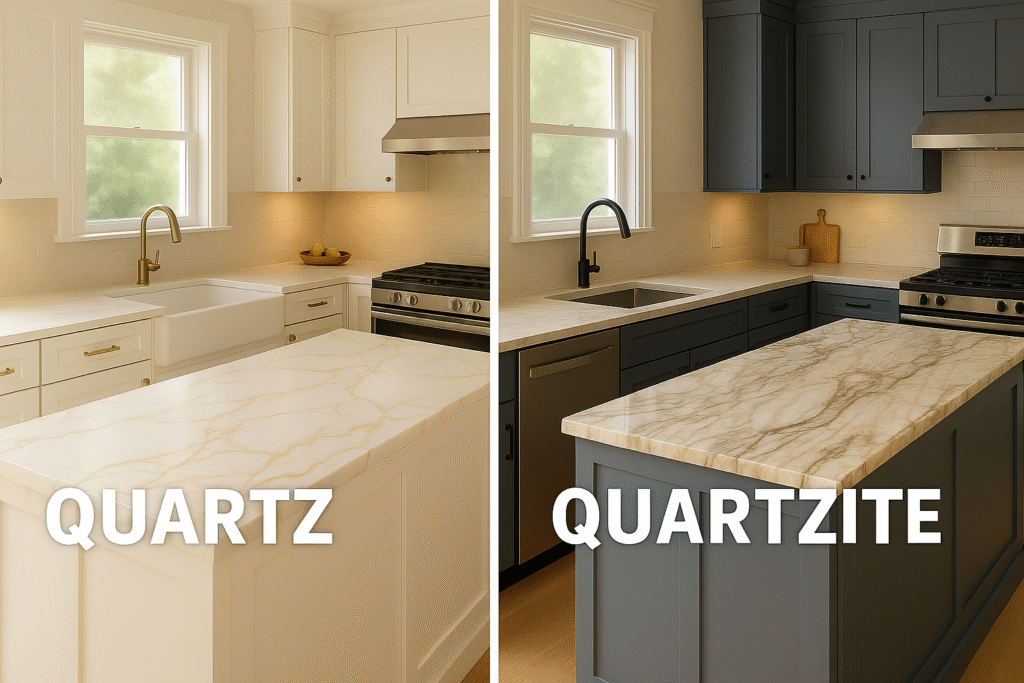
Quartz, Quartzite? Both sound the same, right? Nobody can guess that these are a different type of material used to create worktops. People in the UK often use these names interchangeably. But there is a big difference between them (as we have mentioned it). The thing is that there is a big difference between the two materials.
In all this chaos, it is utterly important to consider another question: Which Is Best for Worktops: Quartz vs Quartzite. The answer to this question will illustrate their differences. You will find pros and cons of quartz and quartzite, too. So, it’s a good idea to continue reading this guide. It’ll help you choose the right material for your newly designed kitchen and bathroom.
Is Quartz Worktop Better Than Quartzite Worktop?
Yes, quartz countertops are better than granite worktops for many reasons. Although quartz and quartzite countertops are made up of material called quartz, they are still not the same. This is because they contain a common element, quartz, but their compositions are totally distinct (that we will discuss in the next section).
More importantly, quartz is affordable, durable, and non-porous, which requires no sealing. On the other hand, quartzite is naturally made, requires sealing, and it’s less durable in various ways compared to quartz. Quartz is an even better option than granite, marble, and glass.
In the next section, we are going to share a complete picture of both materials. Quartz and quartzite will be questioned in each of the features compared below. Let’s see who will win and become part of your kitchen. Let’s not exaggerate anything further and get straight into our guide.
Quartz vs Quartzite: 15 Best Features Compared
Quartz and Quartzite are popular choices, but their similar names confuse many. Quartz is engineered and known for consistency. Quartzite is a beautiful natural stone with unique variations. So, it is hard to decide between them. We compare 15 key features to help you pick the best surface for your home project.
-
Composition
The stuff inside a worktop matters. It determines the material’s properties and how it behaves. Let’s break down the composition of Quartz and Quartzite worktops.
-
Quartz
Engineered quartz worktops consist mainly of natural quartz crystals. These make up about 90% to 95% of the material. The crushed quartz is mixed with strong polymer resins. These resins act as a binder, holding everything together.
Colour pigments are also added during manufacturing. This controlled mix creates a consistent, persistent, and non-porous slab. It is a man-made composite designed for specific performance traits in kitchens and bathrooms.
-
Quartzite
Quartzite is a naturally occurring stone. It starts as sandstone. Under intense heat and pressure deep within the earth, the sandstone grains and quartz cement recrystallise. This process forms a dense, very hard metamorphic rock.
It is composed almost entirely of natural quartz (SiO2). There are no added resins or binders. Thus, each slab is a product of natural geological processes over millions of years. It is pure natural quartz stone.
Who Wins?
Quartz wins for its controlled and engineered composition delivering consistency. This man-made mix ensures predictable properties. At DIY Kitchens Worktop, you can choose your favourite quartz if you value engineered composition.
-
Appearance
How will these worktops look in your kitchen or bathroom? To answer this, you need to consider aesthetics. Both Quartz and Quartzite are beautiful but in different ways. Let’s see how.
-
Quartz
All homeowners know that quartz excels in offering a huge range of looks. Because it is engineered, manufacturers control the colours and patterns. You can find almost any shade imaginable.
It beautifully mimics the appearance of natural stone, including marble and granite, with realistic veining. At DIY Kitchens Worktop, we have a collection of granite, natural stone, and marble effect quartz. You can also get bold solid colours or unique modern designs.
Its controlled manufacturing guarantees consistent appearance and uniformity from one slab to the next. This design freedom is a great advantage which is not available in any other material.
-
Quartzite
On the flip side, quartzite offers the unique, raw beauty of natural stone. Its appearance features stunning, often dramatic, veining patterns created by nature. Its colours range typically from white and grey.
But mineral impurities can add touches of pink, red, blue, yellow, or green. In simple terms, every single slab is unique; no two slabs of quartzite are exactly alike. Its aesthetic is sophisticated and natural. It brings the authentic look and feel of geological art into your home.
Who Wins?
Quartz wins for offering variety in colours and patterns. Plus, it has perfect uniformity. Its engineered nature gives unmatched design control. Click here to choose quartz for extensive colour options and consistent appearance.
-
Heat Resistance
Your worktop faces heat from cooking every day. So, kitchen worktops need to cope with the intense heat from cooking. But, can you put a hot pan down without worry? Let’s compare how Quartz and Quartzite perform when things get warm.
-
Quartz
Engineered quartz is pretty good with normal kitchen heat. The natural quartz inside handles warmth well. But did you remember the resins that hold it together? Those resins can get damaged by extreme heat.
Placing a very hot pot or pan directly from the stove or oven can scorch or discolour the surface. So, it is always best practice to use trivets or hot pads to protect your quartz worktop from high temperatures.
-
Quartzite
On the other hand, we have quartzite. It is a natural stone forged under intense heat. This makes it incredibly heat resistant. It can tolerate high temperatures much better than engineered materials with resins.
You can often place hot pots and pans directly on a quartzite surface without causing damage. It handles heat from cooking appliances with ease. This natural resistance is a significant advantage for busy kitchens.
Who Wins?
Quartzite is the clear winner for heat resistance. Its natural formation makes it highly tolerant of high temperatures.
-
Stain Resistance
Kitchens involve liquids and food colourings. You want a kitchen DIY-worktop that cleans up easily and doesn’t hold onto stains. Let’s see which material resists stains better.
-
Quartz
When we talk about stain resistance properties of a material, engineered quartz remains at the top first position. It is a champion against stains. Its composition includes resins that make the surface completely non-porous.
This means liquids like coffee, wine, oil, tea, and juice simply cannot soak in. Spills just sit on top. This makes cleanup effortless with just soap, cotton cloth, and water. You don’t need to worry about rushing to wipe up every drip.
This non-porous quality also makes it highly resistant to moisture and water damage.
-
Quartzite
Contrarily, natural quartzite is relatively dense and has low porosity, which helps resist stains. However, the porosity can vary between different slabs depending on the stone’s geological formation. So, it is obvious that some quartzite will absorb liquids if not properly sealed.
While pure quartzite is resistant to etching, hybrid quartzites (which contain some marble) are not. That’s why sealing every year is recommended to enhance stain resistance and protect the surface long-term.
Who Wins?
Quartz is the winner for consistent stain resistance without needing sealing. Its engineered non-porous surface blocks spills completely. So, let’s pick quartz for worry-free cleanup.
-
Maintenance
Nobody wants a worktop that’s a chore to keep clean and protected. Maintenance is a key consideration. Let’s compare the care needed for Quartz vs Quartzite worktops.
-
Quartz
It is incredibly easy and simple to maintain engineered quartz worktops. Its non-porous surface means daily cleaning only requires warm water and mild soap. Spills wipe away effortlessly.
Did you know the best part of quartz maintenance?
Quartz never needs sealing. This saves you time and effort throughout the years. Its stain-resistant nature means you don’t have to worry about spills soaking in. In conclusion, it is designed for minimal maintenance while fitting perfectly into a busy lifestyle.
-
Quartzite
Hmm…quartzite requires a bit more care than quartz. Although durable, most quartzite benefits from periodic sealing. This helps protect it from stains and potential etching. The frequency of sealing depends on the specific slab’s porosity. But it is needed annually or after three years.
Besides that, you need to clean daily spills with mild soap and water. Moreover, wipe up acidic substances quickly to avoid dull spots or etching, especially on less pure quartzite.
Who Wins?
Quartz is the winner for lowest maintenance. It never requires sealing and resists stains without extra steps. Here, we provide quartz for the easiest long-term care.
-
Durability
Worktops face constant use. Definitely, you don’t need a surface that can’t stand straight against the daily wear and tear. Let’s walk through the durability of quartz worktops and quartzite worktops.
-
Quartz
Engineered quartz is made for tough daily use. It ranks high on the Mohs hardness scale. This makes it very resistant to scratches from normal kitchen activities. Its engineered nature also helps it resist chips from minor impacts.
Still, significant force can still cause damage even though it is very hard. If chips or cracks do occur, achieving an invisible repair is challenging because of the consistent pattern of the material.
-
Quartzite
Natural quartzite is also extremely durable. As a stone composed almost entirely of quartz, it is one of the hardest natural worktop materials available. This makes it highly resistant to scratches, even more so than many granites.
It stands up well to daily impacts and general wear. However, significant chips or cracks are difficult to repair like other very hard stones. Usually, you require professional attention here.
Who Wins?
Both materials offer excellent durability and scratch resistance properties. They are equally tough surfaces for busy kitchens. It is a tie for overall durability against physical damage.
-
Edge Profile
The edge of your worktop adds design flair and affects its feel. Our manufacturers at DIY Kitchens Worktop can shape different materials into different edge profiles. Let’s see the edging options for quartzites and quartz kitchen worktops.
-
Quartz
Our quartz countertops offer fantastic flexibility for edge profiles. As you know it is manufactured with uniform consistency, you can cut and polish it into almost any edge style imaginable.
You can choose from simple eased or bevel edges to more complex designs like bullnose, shark nose, or Ogee+Scotia. The material holds crisp lines beautifully. Its predictable nature means you get a precise, clean edge profile across your entire DIY worktop run.
-
Quartzite
You fabricate quartzite (being a very hard natural stone) into many standard edge profiles. Some of the common and durable choices are simple eased, bevel, and bullnose edges.
However, carving extremely intricate or delicate edge profiles is more challenging for fabricators compared to engineered stone. The natural grain and hardness mean some complex shapes are less durable or harder to stay perfect. But standard profiles are best suited here.
Who Wins?
Quartz wins for offering a wider variety of precise and complex edge profiles. Its engineered consistency allows for more intricate and cleaner cuts. So, why not choose quartz for maximum edge design options?
-
Eco-Friendly
We want durable materials that are also kind to the planet. So, why not just look at the environmental footprint of Quartz and Quartzite worktops?
-
Quartz
Did you know engineered quartz has environmental considerations related to its production? Its manufacturing or composition process uses substantial energy. Also, it involves resins, which are made from petroleum.
Some manufacturers improve their eco-friendly profile by incorporating recycled glass, mirrors, or stone waste into the mix. Terrazzo quartz countertops are the best example of it. Although durable and long-lasting, it is a product of industrial processes. It is not simply extracted from the earth.
-
Quartzite
As we have said before, quartzite is a completely natural stone that is quarried directly from the ground. This process does have environmental impacts, including energy use for extraction and transportation, and potential disruption at the quarry site.
However, it requires no manufacturing involving chemical resins. Its natural state and extreme durability mean it lasts a very long time. As a result, it’s a way of reducing the need for replacement and thus minimizing future waste.
Who Wins?
As a purely natural material, Quartzite often gets the nod for eco-friendliness. It avoids energy-intensive manufacturing with resins but it also disrupts the natural ecosystem as it is extracted deep from the Earth. So, it’s a tie.
-
Property Value
It is a great way to upgrade your kitchen as it boosts property value. So, buyers notice worktops immediately as it is a focal point in your home, restaurant, building, apartment, or any other property. Let’s see how quartz kitchen worktop vs quartzite influence the market appeal of your home.
-
Quartz
Installing quartz worktops is widely recognised as a valuable upgrade by real estate professionals and potential buyers. Its modern look, vast design choices, and famously low maintenance are major selling points. Buyers love a beautiful kitchen that is easy to care for.
It showcases an updated and high-quality home. Many buyers consider it a premium feature. Local real estate data often shows homes with quartz attracting strong interest.
For example, one agent reported a home selling quickly. The buyers specifically praised the durable and stylish quartz kitchen counters.
-
Quartzite
Quartzite also adds significant value and a touch of luxury to a home. Its unique natural patterns and high-end aesthetic appeal to buyers seeking premium and authentic materials. It is seen as a step up from many standard options.
However, it is perhaps not as universally known by name as quartz. Its natural beauty makes a strong impression. Quartzite is a highly desirable feature that can command a good price for buyers who appreciate natural stone.
Who Wins?
Quartz has a slightly broader appeal to the average buyer today. Its reputation for low maintenance is a universal draw. It’s time to choose quartz for a worktop most buyers will recognise and desire.
-
Indoor & Outdoor Use
Not all worktop materials handle direct sunlight and outdoor conditions well. UV rays can cause damage over time. Let’s see if Quartz or Quartzite are better for sunny spots, UV-rays oriented areas, or outdoor kitchens.
-
Quartz
Engineered quartz is made for indoor environments. Its resins are sensitive to prolonged exposure to direct UV rays from sunlight. Over time, this can cause the colours to fade or the surface to yellow. For this reason, quartz is not recommended from our experts and professionals for outdoor kitchens.
You should also be cautious using it near large, uncovered windows that receive intense, direct sun throughout the day. Its appearance can change if constantly exposed.
-
Quartzite
Let’s share if quartzite is better for indoor and outdoor use. It is a natural stone and is highly resistant to UV rays. Direct sunlight does not cause fade or change its colour permanently.
This makes it a much better option for areas with significant sun exposure. Pure quartzite kitchen countertops can even be used in outdoor kitchen environments. It handles temperature fluctuations reasonably well. Still, proper installation and potential sealing are essential for longevity outdoors against all weather elements.
Who Wins?
Quartzite is the clear winner for outdoor and sunny indoor use due to its natural UV resistance. It won’t fade in sunlight. Choose quartzite if your worktop faces direct sun. However, if you want to use quartz outside, we have premium quartz worktops that are available in high-quality.
-
DIY-Kitchen Projects
Handling and fitting worktops is a significant task in a DIY project. It is important to know if a material is suitable for self-installation. Let’s see how Quartz and Quartzite countertops fare for DIYers.
-
Quartz
Installing engineered quartz worktops is not a typical DIY job for most homeowners, designers, fabricators, and installers. The slabs are extremely heavy and require specialised lifting equipment to move safely. Cutting the material accurately, especially for sink or hob cutouts, needs professional-grade tools and expertise.
Besides that, proper seam creation also requires skill. Professional installation ensures correct support, a secure fit, and usually maintains the warranty. It is highly recommended to hire fabricators for installation.
Still, if you have will, you can do it with proper tools, expertise, and knowledge. It is not recommended but you can do it in your weekends, holidays, and spare time. It is a fun way to do DIY work in your free time.
-
Quartzite
Natural quartzite is also very challenging for DIY installation. Similar to quartz, the slabs are exceptionally heavy. It demands special handling and multiple strong people. Cutting this very hard natural stone requires specific diamond tools and considerable skill to avoid errors or breakage.
So, achieving precise fits and smooth seams is difficult without professional experience. Due to its weight, hardness, and value, professional installation is strongly advised for quartzite. It guarantees safety and a quality result.
Who Wins?
Neither material is recommended for DIY installation by the average homeowner. Both require professional tools, handling, and expertise. Plan for professional help regardless of your choice.
-
Price
Worktops are a significant investment in your kitchen or bathroom. Understanding the cost helps you budget effectively. Let’s compare the typical price points for Quartzite and Quartz.
-
Quartz
Engineered quartz kitchen worktops fall into a mid to high price range. The cost depends heavily on the specific design you choose. Simpler and solid colours are usually less expensive.
Patterns that convincingly mimic rare natural stones, like certain marbles or granites, are available at a higher price. While not the cheapest option available, its price is more predictable than natural stone. Installation costs are also a factor to include in your budget planning.
-
Quartzite
Natural quartzite is considered a premium worktop material. Its price can vary considerably depending on the quarry from where it comes. Plus, the unique characteristics of the slab, such as colour rarity and veining intensity, decides its final price.
Exotic or highly sought-after quartzite patterns are quite expensive. It often sits in a price bracket similar to or higher than many granites and marbles. Its natural origins and unique beauty contribute to its cost.
Who Wins?
Quartz is more budget-friendly with a wider range of accessible price points. Its pricing is more predictable. Let’s choose quartz if you are looking for more consistent and potentially lower costs.
-
Thickness
Worktops come in different thicknesses. This impacts the visual style and the weight of the material. Let’s compare the standard thickness options for both type of worktop surfaces.
-
Quartz
Quartz worktops are available in consistent standard thicknesses. Common options include 12mm, 20mm, and 30mm. The manufacturing process ensures uniform thickness in the entire slab.
Thinner options like 20mm are popular. You can combine them with built-up edges to create the appearance of a much thicker slab without the added weight or cost. This offers design flexibility.
-
Quartzite
Natural quartzite slabs are available in standard thicknesses, most commonly 20mm and 30mm. Its thickness is consistent within a single slab, but variations will occur naturally.
When you will indulge in the thicknesses of quartzite, you will see that other thicknesses are also available but 20mm and 30mm are the most widely used for worktops. Credit goes to the balance of weight, durability, and cost. This shows thicker slabs offer a more substantial look but increase weight and material cost.
Who Wins?
Quartz wins for offering a slightly wider standard range of consistent thicknesses. It ensures uniformity across slabs that help you choose quartz for precise and varied thickness options.
-
Feel / Texture
Worktops are not just for looking at; you interact with them constantly. The surface feel is part of its appeal and vibe. Let’s compare Quartz texture vs Quartzite texture.
-
Quartz
Generally speaking, engineered quartz has a very consistent and smooth feel. The surface is non-porous and uniform because of the resins and controlled manufacturing process. Most quartz comes with a highly polished finish.
This give it a slick and glossy smoothness. Matte or honed finishes are also available to provide a soft and low-sheen texture. Regardless of the finish, the texture is predictable and uniform across the entire slab.
-
Quartzite
Natural quartzite has a smooth finish when polished. However, its texture (being a natural stone) have subtle variations due to the natural grain and mineral composition. In addition to that, the polished quartzite is very smooth to the touch.
Still, some perceive a slight difference compared to the engineered smoothness of quartz. There are different finishes like honed that will also alter the feel. They offer a less reflective and sometimes slightly more textured surface depending on the specific stone.
Who Wins?
Quartz wins for consistent, predictable, and uniform smoothness and texture across the entire surface. Its nature guarantees a reliable feel.
-
Chemical Resistance
Kitchens use various cleaning agents, and sometimes stronger chemicals might spill. How do these worktops handle exposure to different substances, including acids?
-
Quartz
Quartz is highly resistant to most common household chemicals. Its non-porous surface prevents chemicals from penetrating. Mild acids, alkaline solutions, and standard cleaning products will not harm the surface.
However, exposing quartz to very strong chemicals can damage the resin binder. These chemicals could be paint strippers or highly concentrated acids over extended periods. So, wiping up spills promptly is always advisable to maintain its integrity.
-
Quartzite
Pure natural quartzite is very resistant to chemical damage, especially etching from acids. Unlike marble or limestone, its high quartz content means acids like lemon juice or vinegar will not leave dull or etched marks.
But some stones marketed as quartzite may contain other minerals which can etch. Calcium carbonate is one of those chemicals. Testing a sample is wise if etching resistance is a top concern.
Who Wins?
Pure Quartzite wins for its natural resistance to etching from common kitchen acids. This protects its finish from everyday spills.
Final Score: Which is Best: Quartz or Quartzite?
We compared both worktops on 15 key factors. Quartz won in 9 categories, including Appearance, Maintenance, Price, and Property Value. On the flip side, quartzite was the winner for Heat Resistance, Indoor/Outdoor Use, and Chemical Resistance. Interestingly, durability, Eco-Friendliness, and DIY Installation ended in a tie. Based on our head-to-head analysis and scoring, engineered Quartz takes the winner trophe. Its performance and practicality in most common kitchen scenarios is mind-blowing.
If you are interested to get your quartz worktops from one of the leading providers all over the UK, “DIY Kitchens Worktop” is here for you. Call us at 01923223859 or 07432065334.


